The Apprentice Who Was Never Trained
Thesis. The master-apprentice relation made workers in part by making them watch. A guild apprentice spent years inside the master's habits — his patience under bad materials, his refusals, the wrong cuts he didn't make. None of that travelled through a content library or a multiple-choice exam. When we replaced apprenticeship with curriculum, we kept the verb (training) and lost the noun (the trained). The credential industry has been distributing reading lists ever since and calling it formation. The result is a workforce that knows the answers and cannot do the work — which is a strange definition of trained.
The master-apprentice model shaped skilled workers by immersing them in the realities of their trade. Apprentices learned by observing their master’s judgment and decision-making firsthand. These are not qualities you can teach through content libraries or measure with exams. When formal curriculum replaced apprenticeship, we kept the language of 'training' but lost the deeper process of forming true professionals. Today, credentialing often means distributing reading lists and calling it preparation. The outcome is a workforce that can recite answers but struggles to apply them in real situations.
A Medieval Scene
Consider the medieval guild apprentice. A twelve-year-old might spend years carrying water, sweeping floors, and watching every move the master made before ever touching the main tools. This was not wasted time. It built the habits, standards, and attitudes that defined real skill. The apprentice learned to judge materials, decide when to accept or reject a batch, handle mistakes, and know when to call it a day. These lessons came from lived experience, not from manuals. Apprenticeship was once the foundation of professional formation, but modern credentialing has replaced it with content delivery. The master-apprentice relationship shaped character, judgment, and skill through shared work. Today, training often means reading lists and tests, producing workers who know the answers but cannot act. To build real expertise, we need to look beyond credentials and return to the deep practice of apprenticeship.
This approach to learning stands in sharp contrast to modern credentialing. Today, training is often reduced to a checklist: read the assigned texts, pass the exams, and collect a certificate. The focus is on gathering information, not building judgment or character. The result is a workforce that knows the theory but is unprepared for the real challenges of the job.
The University Swap
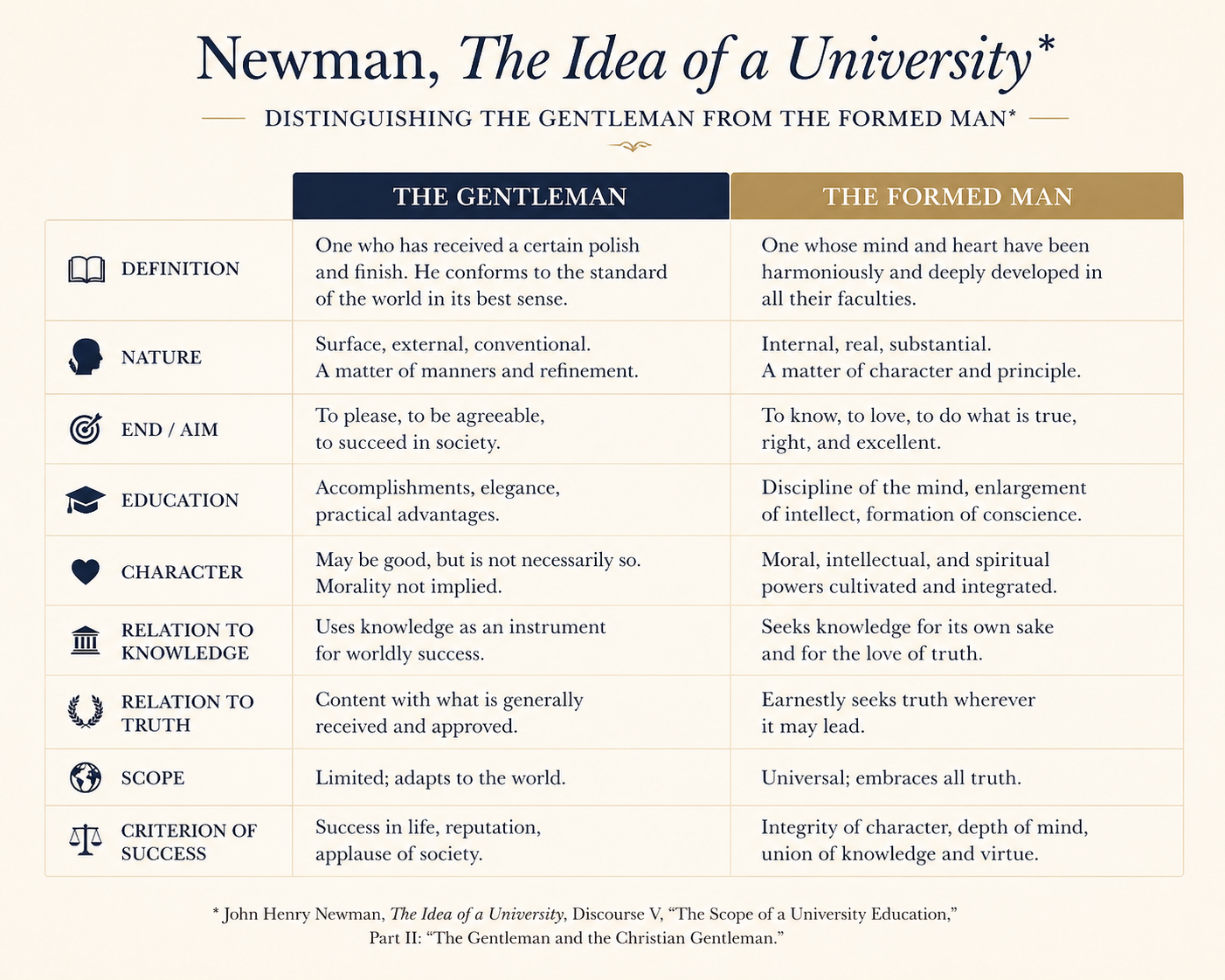
Universities, especially after reforms in the nineteenth and twentieth centuries, moved even further from real professional formation. Early universities were communities of study, but later models focused on credentials and standardized courses. Degrees became proof of completion, not proof of readiness. As Newman observed, education began to separate the broadly educated from the truly prepared professional. In the guild system, a twelve-year-old apprentice might spend years assisting the master before ever laying a brick. By the time he picked up a trowel, he understood the work deeply.
The loss of apprenticeship means modern training programs miss the most important parts of professional development. Qualities like reliability, good judgment, and adaptability cannot be taught in lectures or online courses. They come from close mentorship and real-world practice, just as in the master-apprentice model. Decades of training have produced many certifications, but few professionals who can handle complex challenges. Employers often discover this too late. New hires may look good on paper but struggle when real problems demand initiative and adaptability. Instant-answer tools make it even harder for learners to develop real thinking skills. The solution is not just to improve curriculum, but to bring back the spirit of apprenticeship. With hands-on, guided learning, we can prepare professionals who are not only knowledgeable, but capable and wise.
In short, the shift from apprenticeship to credential-based training has changed both how we educate and what we value. Universities and training programs now focus on surface achievements, often losing the deeper learning that once built real expertise.
In the twentieth century, higher education kept using the word 'training,' but left the practice behind. Curriculum became just a set of content, and a degree became a checklist of requirements. Neither approach truly formed professionals. Earlier universities, before the Bologna reforms, saw themselves as places to study, not as places to build professionals.
Even the most advanced training programs struggle to teach qualities like sound judgment, resilience, and adaptability. These traits develop through experience, mentorship, and steady exposure to real challenges, just as the master-apprentice model provided. No amount of content can replace the human process of formation that happens in close, hands-on relationships.
After decades of training programs, we have many certifications but not enough professionals who can handle complex challenges. The reliability that comes from apprenticeship cannot be taught through a slide deck.
To address the gaps in today’s workforce, organizations need to look beyond credentials and standard learning. By bringing back apprenticeship through mentorship, real-world experience, and long-term guided practice, we can prepare professionals who have both knowledge and the judgment and adaptability needed today.
Today, the problem is even clearer. We have instant-answer tools, learners who have not learned to ask good questions, and employers who hire for credentials but find new hires unprepared for real work. The solution is not just to improve curriculum, but to return to hands-on, guided learning as apprenticeship once offered.
- Thomas Aldric