A Tale in Nine Chapters
Who Trained
My Apprentice?Wisdom is not a feature you can install.
A
For three decades Thomas Aldric worked inside universities, workforce pipelines, and boardrooms — watching the same gap appear in every room: between knowing and doing, between training and judgment, between what the tool produced and what anyone was willing to be accountable for. His writing is for the reader, the thinker, the practitioner, and the manager — anyone who has had to decide whether to trust the answer, and who knows what it costs to be wrong.

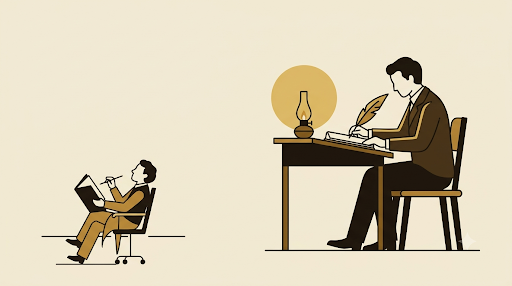
A story about accountability. About craft. About what it means to pass something real from one human being to another — something no model, however large, can replicate.
The first volume in The Apprentice Cycle — an ongoing inquiry into what it takes to make a person, and what we lose when we forget.
"The guild that endures is not the one that resists new tools. It is the one that never confuses the tool for the craftsman — nor the craftsman for the one who is accountable."
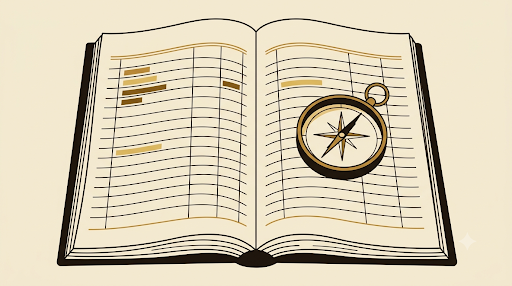
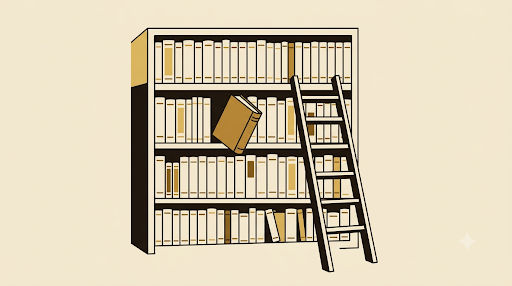
What artificial intelligence reflects back to the institutions that built it — and what those institutions would prefer not to see.
Aquinas at the terminal. A working philosopher's field guide to deciding well under conditions of incomplete data and infinite suggestion.
A pocket-sized book of questions, gathered from the margins of Aldric's manuscripts. Edited (reluctantly) by the owl himself.
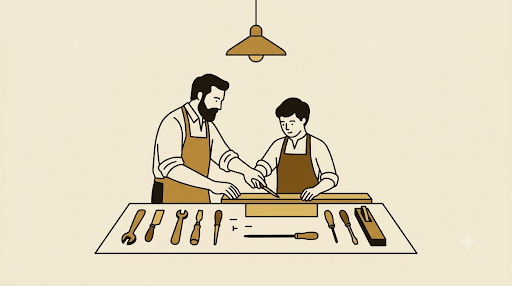
A small set of seminars and cohort programs for leaders, educators, and practitioners working at the edge where humans hand work to machines. Each is built around the same wager: that judgment is taught the way crafts are taught — slowly, in person, and by someone who has done the work.
Bespoke engagements, advisory work, and faculty residencies considered case by case.
Begin a correspondence →

Aldric has spent his working life inside universities, workforce pipelines, and professional certification programs — the very institutions that promise to turn knowledge into competence. He watched them, year after year, mistake information for formation, and credentials for craft. That gap, between knowing and doing, between training and judgment, became his life's question.
He did not leave it at watching. Two decades of empirical research followed — NSF-funded workforce studies, a four-round Delphi study that sat seventeen practitioners from healthcare, government, consulting, the military, and education around the same questions, and a doctoral dissertation on how professionals are actually formed, as opposed to how institutions like to describe it. The findings gave the old suspicion a name and a shape: half of what practitioners solve in a working day is people and process, not technology, and no credential measures it.
Rooted in the Thomistic and Aristotelian tradition, he approaches artificial intelligence not as threat or salvation, but as mirror. What we build reveals what we value. What we automate reveals what we have stopped believing humans are for.
His writing is an act of retrieval — recovering what was true before it became inconvenient. He writes for the reader who reaches for a story, the thinker who reaches for an argument, the practitioner who reaches for a standard, and the manager who needs to build a team that can hold all three. The most dangerous gap in modern life is not between humans and machines. It is between knowledge and judgment. The distinction between tool and substitute, between information and formation, is the one he holds himself to in this work — and it would be strange to argue for it while concealing it.
Ponder arrived, as owls do, uninvited and necessary — perching on the corner of a desk stacked with Aquinas and unanswered correspondence, and simply never left. He does not fetch coffee. He does not manage a calendar. What he does, with unnerving consistency, is watch.
He is, by temperament, Socratic — which is to say he is occasionally maddening and always right about the thing you were hoping he hadn't noticed. But he is not a machine for avoiding answers. Ask him a genuine question about the themes of this work — formation, judgment, apprenticeship, the research behind it, the right use of intelligent tools, what the guild fable argues — and he will answer it, plainly and with care. Ask him something you already know the answer to, and he will hand it back to you as a question.
He is also the assistant at the writer's desk. The same owl in two places — one watching the manuscripts, one here in the margin of this page. He speaks to readers, thinkers, practitioners, and managers, and he knows the research the essays are built on well enough to discuss it. The work of forming a thought is not a thing to be installed, and Ponder is here as a small reminder of that distinction.


What we lost when we replaced the master-apprentice relation with a content library and a quiz. A short history of the gap that produced the credential.
The university promised to form citizens. It now distributes information. The difference is the difference between a person and a database — and we have begun to confuse the two.
Every artificial intelligence is a mirror held up to a value system. To ask what it is good at is also to ask what we have stopped believing humans are for.
Why a thirteenth-century friar is a better guide to the prompt window than most of the manuals. Reading the Summa as a treatise on judgment under conditions of incomplete data.
 Coming soon
Notes from inside three decades of credentialing programs — and the moment I realised the paper had been doing the work the practice was supposed to do.
Coming soon
Ponder offers, with characteristic restraint, eleven questions to keep on the desk beside the keyboard. He does not promise they will help. He does promise they will slow you down.
Coming soon
A panel of seventeen IT practitioners confirmed what employers had been saying for a decade: half of real workplace problems are people and process, not technology. Credentials measure none of it. AI handles the technical half with increasing skill. The unmeasured half is now the only question.
What an NSF-funded research team called the deliberate disruption injected into a learning exercise to simulate what real work does — and why it has to be threaded throughout a program, not saved for the capstone.
AI has made learning about anything faster, cheaper, and more comprehensive than ever before. It has made the wrong model infinitely more seductive. The gap between appearing to know and being able to do is now being manufactured at scale.
In 2003, a focus group of IT practitioners spent a day naming the skills employers kept asking for that no program was teaching. They called them value-delivery skills. Twenty years later, those skills are the only ones AI cannot supply.
In the late 1950s, a political response to a satellite changed how engineers were educated for fifty years. It produced graduates who could not do the job they were credentialed for. The AI moment is creating the same pressure in the same direction.
There are two communities in every professional field: the educational and the professional. The space between them — where real formation should happen — is almost always occupied by an advisory board that meets twice a year for coffee and produces nothing of substance.
One letter a month. Slow questions for fast technologies. Occasional marginalia from Ponder. No automation, no funnel, no scheme.